ABCD program

Early access to a dental home and preventive services is crucial for establishing good lifelong oral health habits, preventing tooth decay, and addressing dental issues before they become more serious. Continuing these habits into adulthood helps people maintain good oral health with healthy smiles, and improves overall well-being. Scheduling a dental appointment and establishing a dental home by the first birthday is highly encouraged.

Clark County Public Health supports the Access to Baby & Child Dentistry (ABCD) program connecting children from birth to age 6 with Washington Apple Health (Medicaid) insurance to dentists for preventive dental care. The ABCD program is also available for children aged 0-12 who have a WA Medicaid Developmental Disabilities Administration (DDA) designation.

ABCD clients receive annually

  • Two dental exams 
  • Three fluoride applications 
  • Restorative care as needed
  • Two education sessions for parents on maintaining their child's dental health

Benefits of early dental visits for kids

  • Education for parents
  • Ensure baby teeth are healthy
  • Make dental visits a regular part of your child's life
  • Prevent dental pain and disease
  • Provide a positive dental experience
ABCD logo


tag

Narrator: 

Good oral health habits are important throughout your life and during pregnancy. The Access to Baby and Child Dentistry, or ABCD, Program offers preventative dental care for children from birth up to age six.  

[On Screen: A single tooth rotating on a blue background, followed an image of the Clark County Public Health ABCD webpage] 

Anna Cruz: 

The ABCD Program is a public and private partnership in a system of care that connects families with young children, zero to up to six years of age, with Medicaid Apple Health to a dental home.  

[On Screen: Anna Cruz, ABCD Program Coordinator, Clark County Public Health] 

Dr. Michael K. Jensen: 

It's real important to start out young children, um, as seeing the dentist. The American Academy of Pediatric Dentists recommends coming in at one; children are just getting a few teeth in there. So, um, it's a good opportunity to talk to the parents and just talk about nutrition and brushing and, and habits, uh, so that we don't get some early childhood decay – just establishes a rapport, gets a child use to somebody other than the parent working in their mouth.  

[On Screen: Inside of a dentist office with staff doing dental exams on children] 

Narrator: 

ABCD patients annually receive two dental exams, three fluoride applications, and two parent education sessions.  

Anna Cruz: 

My work with ABCD Program includes helping local agencies that provide direct care to families with small children. I receive and respond to referrals. I update and share oral health resources and guide families to schedule dental appointments. I also provide additional support to families when needed to remove barriers such as transportation and access to professional interpreting services, which are all covered by Apple Health.  

[On Screen: Anna Cruz on a phone call with someone referred to ABCD and meeting with clients] 

Narrator: 

ABCD dentists help to improve access to high-quality dental care for children in Clark County. The program’s dental champions work with Clark County Public Health to support the program. They also provide specialty training to general and pediatric dentists on working with young children and children with special healthcare needs. With proper oral health care, parents can ensure their children have a healthy smile and a lower risk of dental disease. Clark County's Nurse-Family Partnership helps parents with this process.  

[On Screen: A child receiving a dental exam.] 

Elise Stills: 

Well, the Nurse-Family Partnership Program works with low-income families – many of which have Washington Apple Health or Medicaid insurance, which the ABCD Program supports. So, we get to work with moms from pregnancy until their child turns two, which is a prime time to connect them with the ABCD program and these early dental services. So usually we fill out a simple referral form and get it over to Anna with ABCD, and then she will reach out to them.  

[On Screen: Elise Stills sitting in the office followed by video of children and moms] 

Narrator: 

Parents can prevent tooth decay by teaching their children how to brush their teeth. They should help their child with brushing until they are six to eight years old.  

[On Screen: Children around a table practicing brushing teeth] 

Elise Stills: 

I often try to start talking about it during pregnancy, certainly in infancy, um, with the goal of them getting that first dental visit by age one. And I do a lot of education on the importance of taking care of those baby teeth. It helps them chew. It helps them talk. It sets the foundation for those permanent teeth. Starting these dental habits young sets that, you know, starts good habits for dental care throughout their life and good oral health.  

[On Screen: Elise Stills sitting in the office followed by young children at the dentist office] 

Narrator: 

For more information about the ABCD Program, call 564.397.7371 or visit clark.wa.gov/public-health/abcd-program. You can also use a free online service to connect with a dentist at dentistlink.org. 

[On Screen: Information slide with ABCD program contact information and Dentistlink URL.] 

Mighty Mouth dentist visit

Healthy snacks


Bedtime routines
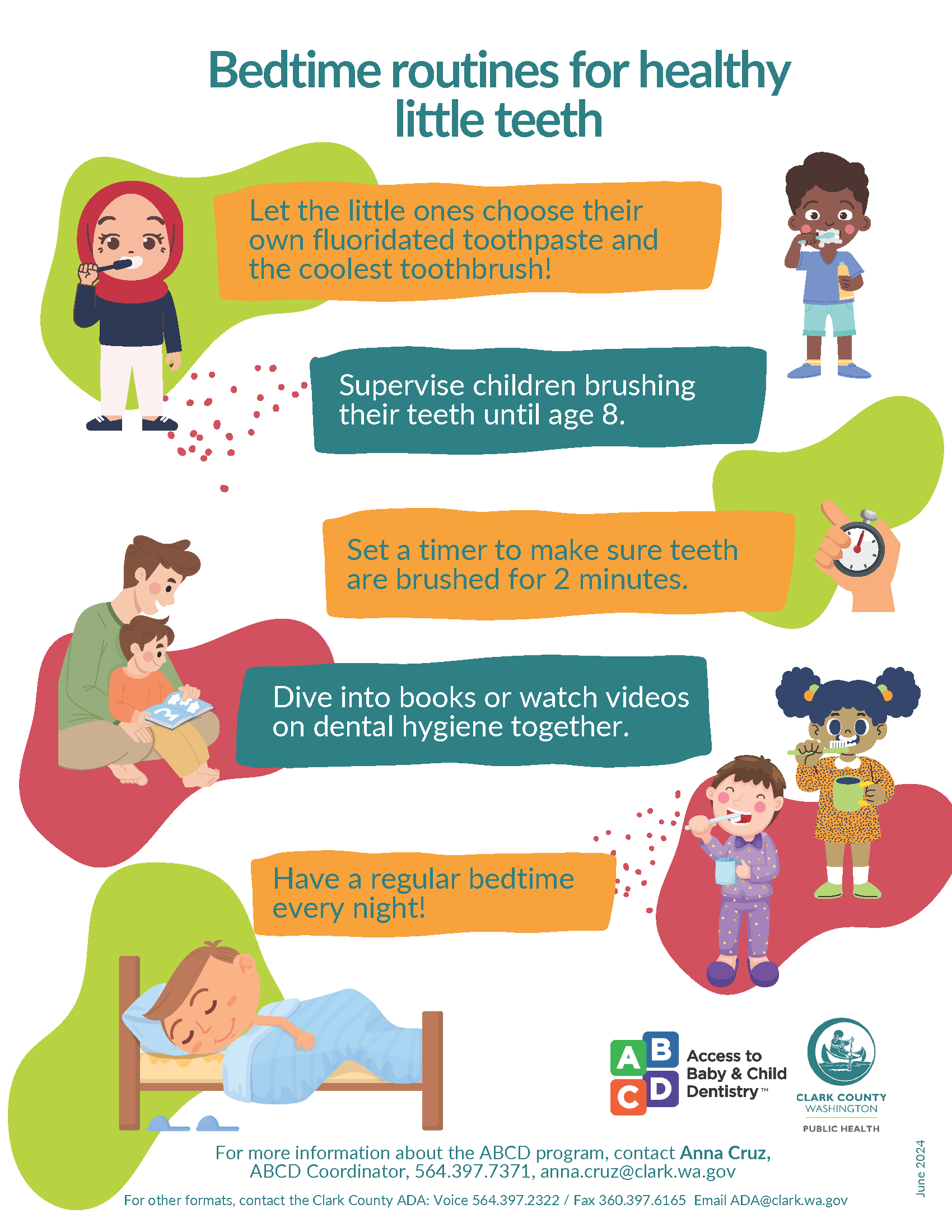
Click to enlarge

The Mighty Mouth provides new mothers with tips on protecting their child's teeth through their own oral health during pregnancy and early years. It also features videos on children's oral health and offers additional resources to teach young kids about dental care.

The Tooth Snack Guide provides snack ideas that are tasty as well as minimize cavity risk and sticky foods to avoid that cause cavities.

Opt for nutritious, tasty, colorful snacks. Don’t replace meals with snacks. Watch out for choking hazards or food allergies.

Resources for ABCD-eligible children

tag
After scheduling a dental appointment for your child, you can request a medical interpreter if needed to communicate with the dentist. This service is included under Apple Health coverage.

Multiple languages
Multiple languages

Una vez que usted ha programado una cita dental para su niño(a) usted puede solicitar un Intérprete médico si lo necesita para comunicarse con el dentista. Este servicio lo cubre Apple Health.

tag

Community in Motion provides non-emergency medical transportation to medical services for individuals covered by Washington state Medicaid (Apple Health).

Community in Motion logo

For more information and details, view a flyer in English.

Oral health tips for parents

tag

With proper oral health care, parents can ensure their children have a healthy smile and lower risk of dental disease as they get older. Parents can prevent tooth decay by:

  • Teaching their children how to brush their teeth
  • Helping their child with brushing until they are 6 to 8 years old
  • Brushing for two minutes, two times each day
tag

Dental sealants are another tool for preventing tooth decay. Dental sealants are thin plastic-like materials painted on chewing surfaces of molars and premolars to "seal out" germs and food that cause decay and destroy teeth. Sealants are effective, safe, easy to apply, long-lasting and cost effective.

tag

Fluoride is a safe, natural mineral that helps prevent tooth decay. For children under 8, it strengthens the developing of permanent teeth. Parents should consult their child's dentist for fluoride recommendations.

Fluoridated water area maps in Clark County 2020

Oral health education & training resources

This section includes our Train the Trainer PowerPoint presentation and printable oral health education materials designed to support educators, family advocates, and community partners in promoting healthy teeth for children and families.

Whether you're integrating oral health into your lessons or guiding families through early dental care, these resources are here to help.

Feel free to download and share!

Capacitación para Entrenadores: Recursos de Educación en Salud Bucal

¡Bienvenidos! En esta sección encontrará la presentación en PowerPoint y materiales digitales imprimibles sobre educación en salud bucal, diseñados para apoyar a educadores, promotores, y aliados comunitarios en la promoción de dientitos saludables para niños y familias.

Ya sea que esté integrando la salud bucal en sus lecciones o guiando a familias en el cuidado dental temprano, estos recursos están aquí para apoyarle.

¡Siéntase libre de bajar los documentos y compartir!

Resources for teachers

10 Minutes for Teeth is a simplified curriculum for teachers that is easy to teach and was developed by a dental hygienist. It’s a free oral health education curriculum available thru the Arcora Foundation. The purpose of this curriculum is to teach the importance of oral health to K-6th grade students. It also has optional materials and activities for children with special needs.

Other dental resources

tag

Brochure with free or low-cost dental resources.

Oral health for people with special needs

Visit the Oral Health for Children with Special Needs page to review suggestions for dental visits with special needs children. On this page, you’ll find details on the advantages of sensory kits and how they support children during dental visits. 

The Washington State Department of Health provides oral health information for people with special needs featuring a dentist directory, fact sheets and other resources.

For more information, email Anna Cruz, ABCD program coordinator. Ingles- Español.