Winter Weather Response

Responding to weather-related impacts in unincorporated county

Clark County Public Works begins preparing equipment and crews for inclement-weather impacts early in the fall and is ready to respond during this week’s weather event. The department responds to reports of hazards and issues on roads and county properties in unincorporated parts of the county, i.e., areas that are not within a city’s limits. 

  • A tool is available on the Public Works website to find out whether a road or property is within the county’s response area.
  • The tool on the Public Works website also includes links to other agencies for issues with roads or properties within their service areas.
  • Residents can report hazards and issues on county roads and properties (including parks), such as downed trees, standing water/flooding, by calling 564.397.2446 or using the online reporting form. Urgent issues, including those requiring an immediate response outside business hours, should be reported by phone.
  • Downed power lines should be reported directly to Clark Public Utilities.
  • Hazards on state roads (Interstate 5, Interstate 204, State Routes 14, 500, 501, 502, 503) should be reported by calling 911. 

Resources for residents

  • Sandbags are available to residents, for free, at two Public Works locations. Bags and sand are provided; residents need to fill their own bags. The materials are available all hours of the day, all days of the week at:
    • 78th Street Operations Center, 4700 NE 78th St.
    • 149th Street Operations Center, 11609 NE 149th St.
  • Public Works shares information about storm-related closures and impacts to county roads and parks in several ways. Residents are encouraged to:
    • Check Public Works’ social media profiles (Facebook, Instagram and X) for updates, and beware of information, speculation and rumors shared on social media from unofficial accounts.
    • Sign up to receive closure information via email.
    • Sign up to receive news releases via email; news releases are shared with local news media to provide lists of closures and storm-related impacts, and residents can now sign up to receive that same information directly to their email.
    • Check the Public Works News page on the county website.

Important storm safety tips

  • Never drive or walk through floodwaters.
  • Always respect closure signs and barricades – they are there to protect people from hazards and dangerous conditions.  
  • Slow down in areas with water on the roadway, give other vehicles plenty of space and avoid sudden maneuvers.
  • Give crews working in the roadway or right-of-way plenty of space and slow down. Follow all signage and directions given.
  • During gusty winds, avoid wooded/forested areas. Listen and watch for falling branches.
  • Never enter or approach rivers during high water or flooding. Recreational river users (such as anglers) should always wear life jackets when recreating in or near local water bodies, especially in winter, when the water is swift, cold, and carries hazards such as logs and storm debris. 

Our friends at CRESA have power outage safety information and preparedness resources on their website. 

For information about road and park projects, closures, opportunities for community input, and more, residents can follow Public Works on X (formerly known as Twitter), Facebook and Instagram and view information on Nextdoor. Residents can also visit clark.wa.gov/public-works to sign up for email notifications. 


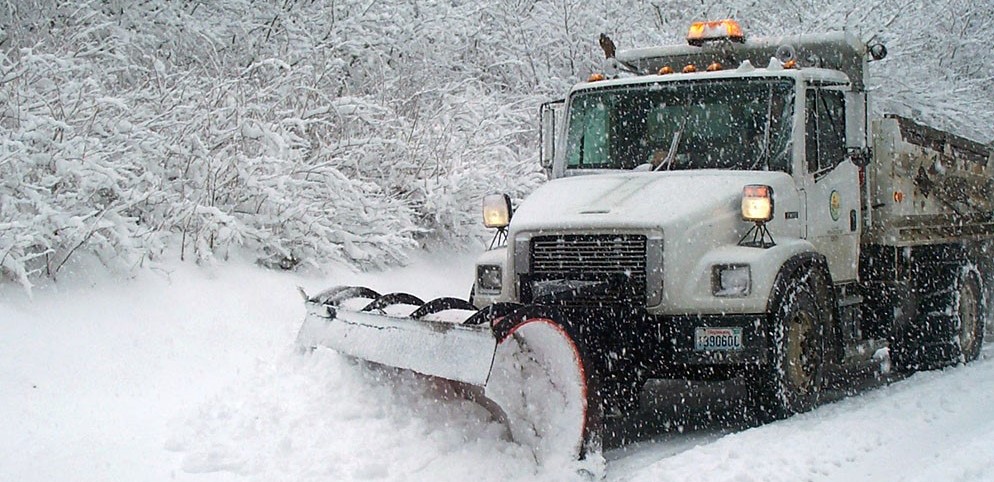
When winter weather strikes, Clark County Public works is ready to respond! Our maintenance and operations crews are located at six “sheds” throughout the county, so we can respond quickly and efficiently to the unique conditions that may occur in different areas. 

Clark County Public Works prioritizes arterials and collectors for plowing, sanding, and deicing. Arterials are the main roads that provide access to highways and freeways and are our top priority. Collectors are roads that provide access to arterials and are the second priority. 


Before winter weather

Each fall, we prepare our staff and equipment so we’re ready to respond to whatever conditions winter weather brings to county roads. We: 

  • Inspect, test and tune up all vehicles and equipment
  • Order salt, make brine and fill storage tanks
  • Familiarize crews with their assigned response routes and equipment; we provide them with handheld response guides for their assigned area
  • Monitor slide-prone areas to proactively prevent landslides

Each truck has a plow and will also have either a sander or deicer. In addition to snow and ice, each truck is prepared to respond to water over roadways, clogged catch basins, downed trees and branches, and similar weather-related issues. 

During winter weather events

tag
What you should do during winter weather
  • Check reliable sources for weather forecasts and information. The most reliable information and alerts will come from the National Weather Service’s Portland office.
  • Stay off the roads during inclement weather when possible. Keeping the roads clear helps us more quickly and efficiently treat the roads and make them safer for everyone. It also keeps the roads clear for emergency vehicles.
  • If you need to travel during winter weather events:
    • Check your route and current conditions before you go. Click here for links to resources.
    • Make sure you and your vehicle are prepared. Have a full gas tank or battery, emergency supplies, traction devices, warm clothes or blankets, food and water. Make sure your cell phone is charged.
    • Not comfortable driving in the conditions? C-TRAN can do the driving for you! Learn more.
  • Report hazardous road conditions. Click here to find out how.
  • Always obey all closures and road signage; it is very dangerous to enter a closure. 
tag
  • When the forecast indicates that winter weather conditions are likely, we have crews report to their workstations earlier in the day. 
  • Staff will work overtime, weekends and holidays as needed to respond to winter weather impacts. 
  • When needed, we shift to a 24-hour schedule and work around the clock to keep the roads in the best condition possible. 
  • We watch the weather carefully and coordinate with our emergency manager. We have procedures to constantly monitor real-time, on the ground conditions. We use that information to identify the best way to respond, whether that’s using sand, deicer or plows. 
  • We prioritize arterials and collectors for plowing, sanding and deicing. Arterials are the main roads that provide access to highways and freeways and are our top priority. Collectors are roads that provide access to arterials and are the second priority. Click here to view our snow route map. 
  • We divert traffic or close a road when necessary for the public’s safety and to protect infrastructure. 
  • We share information, including detours and closures, with the public as soon as it is available. Response information, closures and updates will be posted on our website’s homepage and on our social media profiles (you do not need to have social media accounts to view): Facebook, Instagram and X (formerly Twitter). We post information on Nextdoor too, but Nextdoor requires an account to view information posted by local agencies. 
  • We also share information with local newspaper, TV and radio stations. 
tag

Please exercise caution when visiting county parks and trails, especially when ice, snow or strong winds create hazardous conditions. 

Ice storms can inflict serious damage to trees—uprooting or breaking off large limbs. The weight of snow also increases the risk of falling trees or branches. Strong winds may weaken unstable trees. Be particularly watchful when it is windy or following a snowstorm when branches are covered with snow. Stay out of the forest when there are strong winds. If you are already in the forest when winds kick up, head to a clearing out of reach of any potential falling trees. (Information from the U.S. Forest Service.)

If you are outdoors, move into the closest shelter. Avoid potential hazards such as downed electric power lines, utility poles and trees. (Information from the Washington Emergency Management Division.)

Report down trees, broken pipes and other maintenance issues in parks using our web form

Contact

tag

Resources

Frequently Asked Questions
tag

We prioritize arterials and collectors for plowing, sanding and deicing. Arterials are the main roads that provide access to highways and freeways and are our top priority. Collectors are roads that provide access to arterials and are the second priority. Click here to view our snow route map. 

tag

No. Clark County's plows cannot scrape down to pavement through thick ice or heavy snow, particularly when it has been compacted by traffic. 

tag

Salt brine, a mix of water and salt that is 23.3% salt, is used to pretreat roads before a storm arrives. The solution inhibits ice crystals from binding to pavement. We occasionally sprays salt brine as a deicer once snow or ice has accumulated.

tag

Because of the county’s mild winters, small amounts of salt brine are used infrequently, so the environmental effects on streams, rivers and groundwater is minimal.

The Washington State Transportation Center conducted a study along SR 97 in Chelan County, from December 1999 to May 2000. Despite significant use of chloride (salt) products for snow and ice control, there was no measurable negative impact on Peshastin Creek, a fish-bearing stream that parallels a portion of the state highway.

While the amount and frequency of salt brine applied is minimal, it's a good idea to wash your vehicle following a snowstorm to reduce the corrosive effect on exposed metal.

tag

We use sanding rock on some hills, curves and other trouble spots. In heavy traffic, sanding rock is quickly thrown to the side and must be swept up during post-storm cleanup. It also can clog drainage systems and harm aquatic life if washed into waterways. The cost of applying sanding rock is an expensive alternative at about $93 per lane mile, including post-storm sweeping, compared with $5 per lane mile for salt brine.

tag

Under Clark County Code, the county is not responsible for removing snow and ice from private driveways or roads or at their intersections with county roads. County equipment can be used only for snow removal and ice control on county roads. Clark County Code 12.24.030 - Snow Removal and Ice Control, Driveways and other roads

Property owners are responsible for keeping parking lots, driveways and sidewalks on or along their property free of snow and ice.